Timeswap borrowing
Borrowers lock token collateral in a Timeswap pool to obtain a loan with fixed interest terms and a set maturity. The app's pool-data outage notice says new borrowing is disabled while existing positions can still be closed. Repayment before the pool's exact maturity time is required to recover the collateral.
- Interest terms
- The position's APR is fixed when it opens. Later pool quotes apply to new positions.
- Position record
- An ERC-1155 Collateral Claim Token represents the borrowing position.
- Price-triggered liquidation
- None during the loan. Debt left unpaid at maturity results in collateral forfeiture.
How Are Loan Terms Set?
Each Timeswap pool is identified by its asset pair, transition price and maturity. The amount available to borrow depends on the liquidity that lenders and liquidity providers supply to that pool.
The transition price defines the exchange ratio between the pool's two tokens. CDP helps borrowers assess their loan's collateral factor. The automated market maker quotes interest as participants lend and borrow, without using an external price oracle.
Interest and Fees
Changes in a pool's APR affect subsequent transactions. An existing debt position retains its interest terms until maturity, even when the pool displays a different rate for a new loan.
The documented borrower fee is 10% of the interest paid and goes to liquidity providers. The interface displays borrowing interest inclusive of this fee. The principal plus interest owed on the position determines the repayment amount.
Repayment Before Maturity
Repayment unlocks collateral when it completes before the pool's exact maturity. Timeswap's Borrowing FAQ recommends repaying minutes or hours before expiry because the pool matures at the stated time. Before maturity, borrowers can repay in full to close the whole position or repay partially to close a portion. Early exits may incur slippage. Interest on an early repayment is not prorated; it depends on how long the loan has run, entry and exit rates and the liquidity available when it closes.
Borrowers can leave a loan unpaid, but the collateral is then forfeited at maturity and distributed to lenders and liquidity providers. The transition price indicates where the incentive to repay is expected to change; each borrower's debt and actual decision still matter. A market price crossing that level does not trigger liquidation under the documented loan design.
Collateral and Position Approvals
- Collateral approval
- The permission for opening a borrowing position covers the ERC-20 collateral to be locked in that pool.
- Repayment approvals
- Closing a debt by repaying before maturity requires permissions for the ERC-20 repayment asset and the ERC-1155 Collateral Claim Token. The position token is burned when repayment closes the borrowing position and unlocks the collateral.
The NFT approval described in the Borrowing FAQ authorizes access to Timeswap's position collection and does not grant access to other NFT collections. Granting permission and paying the debt are separate actions; an approval alone does not settle the loan.
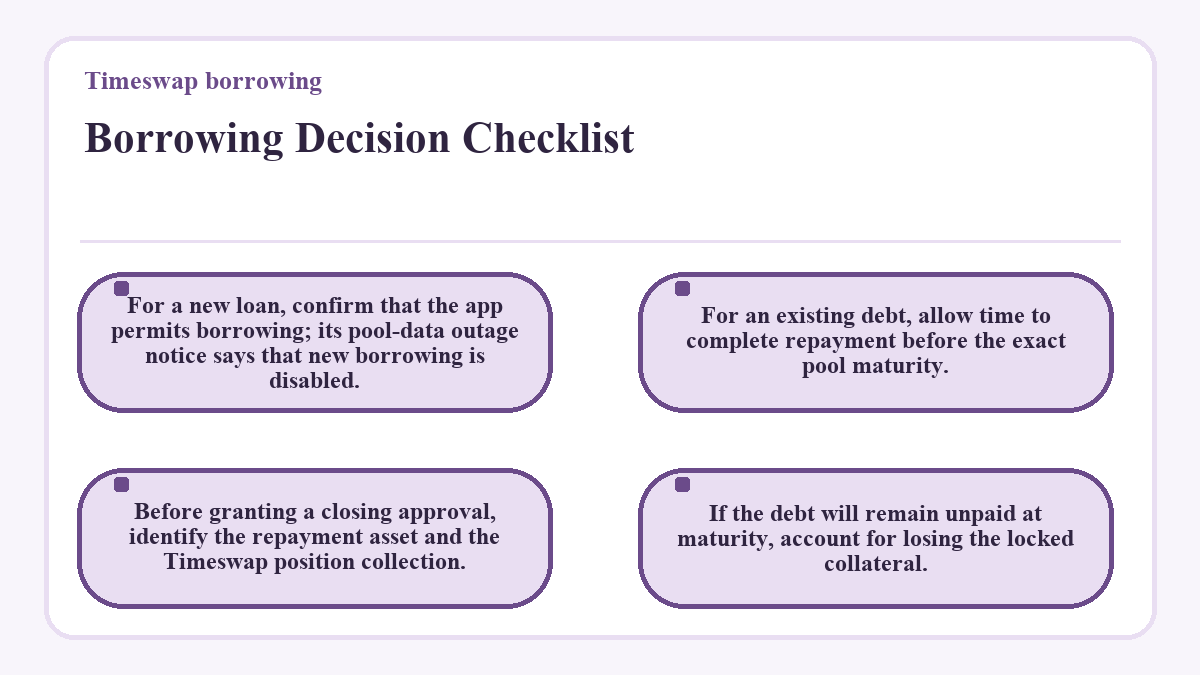
Borrowing Decision Checklist
- For a new loan, confirm that the app permits borrowing; its pool-data outage notice says that new borrowing is disabled.
- For an existing debt, allow time to complete repayment before the exact pool maturity.
- Before granting a closing approval, identify the repayment asset and the Timeswap position collection.
- If the debt will remain unpaid at maturity, account for losing the locked collateral.